Clark family land deed
Where the Crawdads SingThe Clark family land deed is the document that turns Kya’s inherited but uncertain attachment to the marsh into legal title. Its importance lies not only in securing her home: the deed gives official form to a place she has long treated as hers, even while lacking proof that her family owned it. The discovery depends on a family Bible, a county archive, and a rule that makes unpaid taxes a threat to ownership as well as a route to obtaining it.
Identity and Discovery
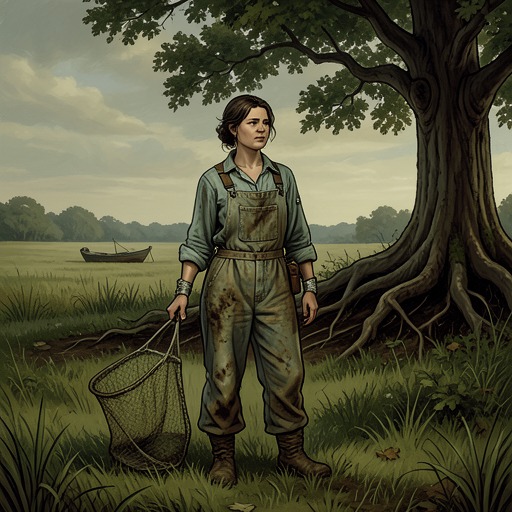
For years, Kya did not know whether her family owned the land or had simply squatted on it, as many marsh residents had done for generations. While looking for clues about Ma’s whereabouts, she had read scraps of paper in the shack without finding anything resembling a deed. The missing document left her relationship to the property intimate but legally unresolved: she knew the boundaries she considered her own, yet had no paperwork to confirm them.
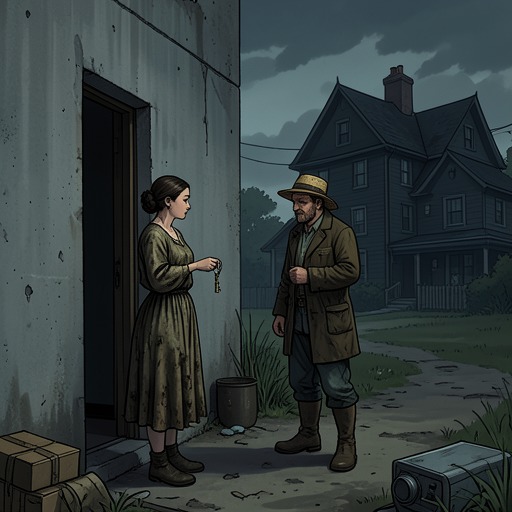
That uncertainty changes when Kya takes the old family Bible to the Barkley Cove Courthouse after visiting Jumpin’. A clerk brings out a large leather record book, maps, and aerial photographs, and Kya traces her lagoon and the rough limits of her land on the map. The search is not a simple retrieval of a document she already knows exists. It is an investigation joining the landscape she recognizes to the county’s recorded history.
The clerk finds that the land was surveyed and purchased in 1897 by Napier Clark. Kya recognizes him as her grandfather, then checks the Bible’s birth and death records and finds the name Napier Murphy Clark. The parallel between the archive and the family record establishes the link she needs: the county’s buyer and the person named in her Bible are the same man. She tells the clerk that her father is dead, though she is uncertain whether he is.
Taxes and Legal Ownership
The deed’s recovery reveals a complication rather than an uncomplicated inheritance. The land has never been sold, the clerk explains, but back taxes remain due. Under the law as he describes it, someone who pays those taxes can acquire the land even without holding a deed. The absence of a sale therefore supports Kya’s claim through the family chain, while the unpaid balance leaves the property vulnerable to someone else who might pay first.
Kya asks how much she owes. She has never opened a bank account, and the cash she has—about three thousand dollars after improvements to her house—is in her knapsack. Expecting decades of arrears to amount to thousands, she learns instead that the land’s classification as wasteland kept most annual taxes to about five dollars. The clerk calculates a total of roughly eight hundred dollars. Paying that sum will put the land free and clear, transforming a record of old ownership into a present legal claim.
The outcome depends on a practical detail of the county’s system: the property has been assessed as wasteland, not as the valuable home Kya knows it to be. The clerk’s calculation converts that undervaluation into an attainable cost of title. What could have been an overwhelming debt becomes a sum she can meet, and the tax rule that threatened to transfer the land to a stranger instead gives her a way to secure it.
The Land the Deed Secures
Kya leaves the courthouse with a full deed in her name for 310 acres on the North Carolina coast. The acreage includes lush lagoons, marsh, oak forests, and a long private beach. These are not interchangeable parcels listed on a page: they are the varied places that make up the landscape she has observed and inhabited. The deed gathers them under one legal description and confirms her authority over the land as a whole.
The county’s label for the property sharply contrasts with Kya’s experience of it. Its records call the terrain wasteland; to her, the lagoon, forests, and beach are a living home. The official category that helped keep taxes low also exposes how little the administrative description conveys about the place’s value to her. The document does not make the marsh meaningful to Kya; it makes that meaning harder for the outside world to dispossess.
As she returns to her lagoon at dusk, Kya tells a heron that its spot is safe. The gesture extends her newly secured ownership beyond private possession: she treats the land as a habitat shared with the creatures she knows, not merely as an asset under her name. The deed settles the question of who legally owns the acres, while her words suggest how she understands the responsibility and belonging that come with them.
Narrative Significance
The deed marks a concrete reversal in Kya’s history of insecurity. Family members have left, and her early uncertainty about the land has persisted alongside her dependence on the marsh. Here, however, she does not have to rely on another person’s promise or on an undocumented family story. She follows the records herself, identifies the ancestor, learns the tax conditions, and pays what is required. The county’s document recognizes a claim she has pieced together through attention and persistence.
The episode also places two kinds of knowledge beside one another. Kya reads the mapped boundaries by locating her lagoon and describing the land as she knows it; the clerk supplies the records and legal mechanism that can make that knowledge enforceable. Neither alone completes the transfer: her understanding identifies the property, the Bible connects her to its recorded buyer, and payment clears the taxes. The deed is the resulting bridge between lived familiarity and public authority.
Its significance continues beyond the courthouse scene as a secure basis for Kya’s life on the coast. The deed does not erase the history of abandonment or the community’s judgment of her, but it establishes that the marsh acreage is legally hers. The contrast between a bureaucratic wasteland classification and the living landscape she returns to gives the document its particular force: it protects the place by translating her long-standing belonging into a form the law recognizes.